
- What Customer Engagement Really Means in 2025
- Why SMS Is the Key to Higher Engagement
- Common SMS Engagement Challenges Businesses Face
- 10 Proven Strategies to Boost Customer Engagement via SMS
- Strategy 1: Send Personalized Welcome Messages
- Strategy 2: Reduce No-Shows With Appointment Reminders
- Strategy 3: Create Two-Way Conversations
- Strategy 4: Send Order and Service Updates
- Strategy 5: Reward Loyalty With Exclusive Offers
- Strategy 6: Recover Abandoned Carts
- Strategy 7: Gather Feedback With Post-Service Surveys
- Strategy 8: Send Birthday and Anniversary Messages
- Strategy 9: Win Back Inactive Customers
- Strategy 10: Provide Urgent Notifications and Alerts
- How to Send Engagement Texts From Your Email Inbox
- Best Practices for High‑Engagement SMS Campaigns
- How to Measure SMS Customer Engagement Success
- Industries That Benefit Most From SMS Customer Engagement
- Start Boosting Customer Engagement With SMS Today
- Frequently Asked Questions
Boost Customer Engagement with SMS
How to Boost Customer Engagement with Effective SMS Strategies

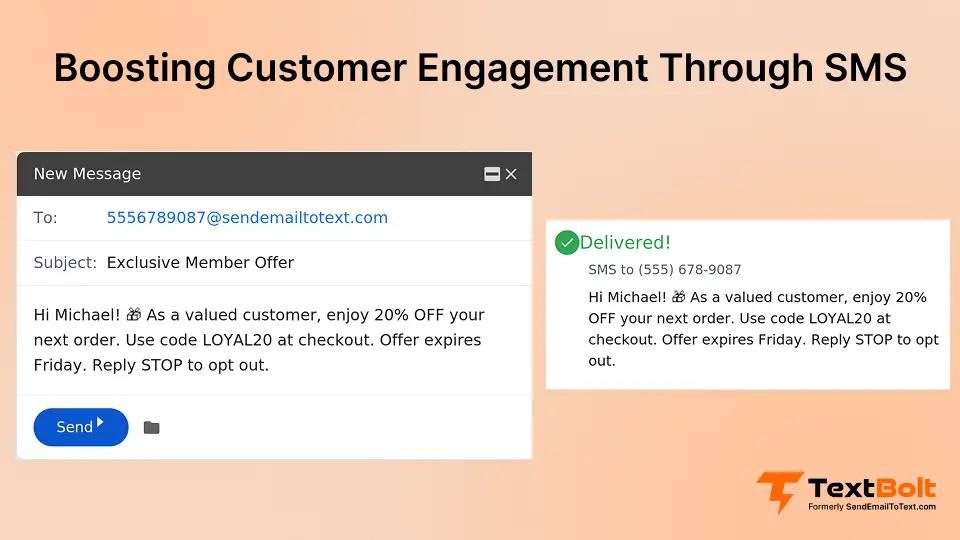
Customer engagement is harder than ever. Emails get buried, app notifications get muted, and customers are constantly overloaded with information.
SMS, however, stands out and actually gets seen. Studies show that text messages can reach open rates close to 98%, and about 90% are read within three minutes, making SMS one of the most reliable ways to connect with customers quickly.
Because of this, businesses of all sizes from clinics and coaching centers to real estate agents and local service providers are moving from email only communication to strategies that put SMS at the center of their customer interactions.
If you want higher response rates, more loyal customers, and faster back-and-forth with your audience, SMS is no longer optional, it needs to be a key part of your communication strategy.
What Customer Engagement Really Means in 2025
To use SMS effectively, it helps to first understand what “customer engagement” actually means today:
- Customer engagement is the ongoing relationship a business builds with customers through meaningful, timely interactions across their entire journey not just at the point of sale.
- It covers every touchpoint where you inform, support, remind, or delight customers, including updates, reminders, help messages, offers, and follow-ups.
- Strong engagement leads to higher satisfaction and retention because customers feel supported and valued, not just marketed to. Businesses that improve communication consistency can reduce customer churn by ensuring important messages are seen and acted on in time.
- Engaged customers are more likely to buy again, spend more, leave positive reviews, and recommend your business, directly boosting revenue and long-term growth.
Why SMS Is the Key to Higher Engagement
SMS matches how customers actually live and communicate today on their phones, in short bursts, and often on the go. That makes it a natural fit for keeping people active, informed, and responsive.
1. Instant delivery and very high open rates
Text messages are delivered within seconds and can reach open rates near 98%, far surpassing typical email campaigns. For time-sensitive updates like confirmations, reminders, reservations, and job application updates, SMS is highly effective.
2. Works on all devices no internet needed
Any mobile phone can receive SMS, even without apps, data, or Wi‑Fi. This makes SMS more reliable than channels that depend on smartphones, installed apps, or push permissions that users may turn off.
3. Customers prefer short, actionable messages
People are more willing to read and act on a short, clear text than a long email or complex app notification. For things like “Confirm your appointment,” “Tap to pay your invoice,” or “Reply YES to renew,” SMS fits perfectly into daily habits.
4. SMS cuts through inbox and notification overload
Email inboxes are crowded, and many users mute or block app notifications to reduce noise. SMS still feels more direct and personal, so customers are more likely to notice and respond to important messages that might be missed elsewhere.
Common SMS Engagement Challenges Businesses Face
Most businesses recognize that SMS customer engagement works, yet many struggle to implement it effectively. Understanding these obstacles is the first step toward solving them.
Challenge 1: Siloed Communication Creates Gaps
When only one person on your team can send customer texts, your engagement becomes fragile. What happens when Sarah calls in sick and she’s the only one with access to your texting system? Appointments get missed. Customers don’t receive confirmations. Revenue walks out the door.
This single point of failure plagues businesses that rely on personal phones or individual logins for customer SMS.
Challenge 2: Complex Platforms Gather Dust
Enterprise SMS platforms promise everything: automation, segmentation, analytics, integrations. But their complexity means staff never fully adopt them. That $300/month platform sits unused while your receptionist texts customers from her personal phone.
The result? Inconsistent messaging, no audit trail, and compliance risks.
Challenge 3: Carrier Gateway Shutdowns Disrupted Everything
For years, businesses relied on free carrier email-to-text gateways like @txt.att.net and @vtext.com. These services shut down in 2025, leaving thousands of businesses scrambling for AT&T email to text alternatives and VText replacements.
Messages that once delivered reliably now fail silently. Automated systems that triggered SMS alerts stopped working overnight.
Challenge 4: Compliance Complexity Creates Fear
TCPA regulations, 10DLC registration, opt-in requirements. The compliance landscape for business SMS intimidates many organizations into inaction. Fear of fines prevents them from leveraging the most effective customer communication channel available.
The good news? These challenges have solutions, and implementing effective SMS customer engagement is more straightforward than most businesses realize.
Engage Customers at the Right Time with the Right Message
Send timely alerts, reminders, and replies all without leaving Gmail.
10 Proven Strategies to Boost Customer Engagement via SMS
These strategies work for businesses across industries, from healthcare clinics to service providers to retail operations. Each one is designed to increase response rates, build customer relationships, and drive measurable business results.
Strategy 1: Send Personalized Welcome Messages
First impressions matter. When a customer signs up, makes a purchase, or books an appointment, a personalized welcome text sets the tone for your relationship. A strong client onboarding sequence via SMS can increase long-term retention significantly.
Why it works: Welcome messages achieve 4x higher open rates than standard promotional texts because they arrive at the moment of highest customer interest.
Example template:
Hi [First Name], welcome to [Business Name]! We’re excited to have you. Reply HELP anytime if you have questions. Text STOP to opt out.
Strategy 2: Reduce No-Shows With Appointment Reminders
Missed appointments cost businesses an average of $200 per occurrence. For a healthcare practice with 50 no-shows per month, that’s $10,000 in lost revenue.
Appointment reminders via SMS reduce no-show rates by up to 38%. The key is timing: send a reminder 24 hours before and again 2 hours before the appointment.
Why it works: Unlike email reminders that sit unread, text reminders appear on the lock screen where customers can’t miss them.
Example template:
Hi [First Name], reminder: You have an appointment tomorrow at [Time] with [Business Name]. Reply YES to confirm or RESCHEDULE to change.
Strategy 3: Create Two-Way Conversations
One-way promotional blasts feel like spam. Two-way conversations feel like relationships.
Enable customers to reply to your texts and respond promptly when they do. This conversational approach transforms SMS from a broadcast channel into a genuine communication tool.
Why it works: Two‑way, conversational SMS campaigns can roughly double or triple response rates compared to one‑way broadcast messages, because customers feel invited to reply rather than just being pushed for promotions.
With TextBolt, customer replies come directly to your email inbox, making it easy for your team to continue conversations without switching platforms.
Strategy 4: Send Order and Service Updates
Customers want to know the status of their orders, appointments, and service requests. Proactive updates reduce inbound support calls while increasing customer satisfaction. This includes payment reminders via SMS that keep cash flow healthy.
Use cases:
- Order confirmation and shipping notifications
- Service completion alerts
- Delivery ETA updates
- Prescription ready notifications
- Vehicle service completion
Why it works: Proactive communication reduces “Where is my order?” calls by up to 60% while improving customer perception of your business.
Strategy 5: Reward Loyalty With Exclusive Offers
VIP customers deserve VIP treatment. Send exclusive promotional offers via SMS and early access to your most engaged customers.
Why it works: Exclusive SMS offers achieve 10x higher click-through rates than email promotions because they feel personal and time-sensitive.
Example template:
[First Name], as a valued customer, you get early access to our summer sale. 25% off starts NOW for you: [Link]. Ends Friday for everyone else.
Strategy 6: Recover Abandoned Carts
For e-commerce businesses, abandoned cart recovery texts can reclaim 10-15% of lost sales. The key is timing: send the first reminder within 1 hour of abandonment.
Why it works: SMS reminders reach customers while the purchase intent is still fresh, unlike email which may not be seen for hours or days.
Example template:
Hi [First Name], you left something behind! Complete your order at [Business Name] and get free shipping: [Link]. Items selling fast!
Strategy 7: Gather Feedback With Post-Service Surveys
Short SMS surveys capture customer feedback at the moment of highest engagement. Keep surveys to 1-2 questions for maximum response rates.
Why it works: Short SMS surveys often see 30–45% response rates, while typical email surveys struggle around 5–10%, giving SMS a clear edge for quick feedback.
Example template:
Thanks for visiting [Business Name]! How was your experience? Reply 1-5 (5 being excellent). Your feedback helps us improve.
Strategy 8: Send Birthday and Anniversary Messages
Personal milestone messages create emotional connections that drive loyalty. A simple birthday discount or anniversary acknowledgment makes customers feel valued.
Why it works: Birthday texts have a 481% higher transaction rate than standard promotional messages.
Example template:
Happy Birthday, [First Name]! Celebrate with 20% off your next visit to [Business Name]. Use code BIRTHDAY at checkout. Valid this week only.
Strategy 9: Win Back Inactive Customers
Customers who haven’t engaged in 60-90 days need a nudge. Win-back campaigns re-engage dormant customers before they’re lost forever.
Why it works: It costs 5x more to acquire a new customer than to retain an existing one. Win-back texts can recover 10-20% of lapsed customers.
Example template:
Hi [First Name], we miss you at [Business Name]! It’s been a while. Here’s 15% off to welcome you back: [Link]. Hope to see you soon.
Strategy 10: Provide Urgent Notifications and Alerts
Critical business communications demand immediate attention. Emergency closures, schedule changes, and time-sensitive updates require a channel customers will actually see.
Use cases:
- Weather-related closures
- Last-minute schedule changes
- Emergency alerts
- Staff sick day coverage notifications
- IT system outage alerts
Why it works: For urgent communications, SMS is the only channel that reliably reaches customers within minutes.
How to Send Engagement Texts From Your Email Inbox
Most businesses assume SMS customer engagement requires expensive platforms, complex integrations, or dedicated apps. The truth is simpler, you can send engagement texts directly from the email you already use.
The Email-to-SMS Workflow Advantage
Instead of logging into separate dashboards, training staff on new platforms, or relying on one person’s phone, email-to-SMS lets your entire team participate in customer engagement. Here’s why this matters for businesses:
- Team Resilience: When any team member can send customer texts from their email, you eliminate single points of failure. Coverage during vacations, sick days, and shift changes becomes seamless.
- Zero Learning Curve: Your staff already knows how to send email. With TextBolt, that’s literally all they need to know.
- Complete Audit Trail: Every text is documented in your email with timestamps, sender identification, and delivery confirmation. Know who sent what and when.
- Professional Appearance: Messages come from your dedicated business number, not random personal phones or carrier gateway addresses.
Getting Started With TextBolt
Setting up email-to-SMS takes about 30 minutes:
- Install the TextBolt Gmail add-on from Google Workspace Marketplace
- Complete business verification for 10DLC compliance (TextBolt handles the paperwork)
- Receive your dedicated business number
- Start sending by composing emails to [phonenumber]@sendemailtotext.com
Customer replies come back to your inbox, keeping conversations in one place. You can even schedule SMS messages using Gmail’s Schedule Send for perfectly timed engagement.
Why Email-to-SMS Beats Traditional SMS Platforms
| Feature | Traditional SMS Platform | Email-to-SMS with TextBolt |
| Learning curve | Hours of training | Zero (you already know email) |
| Team access | Per-user fees | Included for up to 10 users |
| Audit trail | Separate dashboard | In your email history |
| Setup time | Days to weeks | 30 minutes |
| Workflow disruption | New app to switch to | Works from existing email |
For businesses that want effective SMS customer engagement without the complexity, email-to-SMS is the clear choice.
Best Practices for High‑Engagement SMS Campaigns
Strategy alone isn’t enough. How you execute determines whether your SMS engagement thrives or fails. These best practices ensure your messages get read, responses increase, and customers remain engaged.
- Watch your frequency: Avoid texting too often. Focus on useful, timely messages instead of daily promotions, so people don’t feel spammed.
- Send at the right times: Stick to normal daytime hours (for example, roughly 9 a.m. to 8 p.m. in the customer’s time zone) and avoid late‑night or very early messages, which helps enhance customer satisfaction.
- Be clear about who you are: Mention your business name in messages so customers instantly know who is contacting them and why.
- Keep it simple: Customers prefer short, clear texts over long messages that take time to read.
- Always include an easy opt‑out: Add a simple line like “Reply STOP to opt out” so people can unsubscribe if they no longer want texts, which is important for trust and compliance.
- Protect customer data: Avoid sending highly sensitive information by SMS and make sure any stored data is handled securely.
How to Measure SMS Customer Engagement Success
You can’t improve what you don’t measure. These metrics tell you whether your SMS engagement strategy is working.
Key Performance Indicators
- Delivery Rate: What percentage of messages successfully reach recipients? Target 95%+ with a reliable SMS provider. TextBolt achieves up to 98% delivery through 10DLC compliance.
- Open Rate: For SMS, this is typically around 95–98% by default since texts appear on lock screens. Focus on response metrics instead.
- Response Rate: What percentage of recipients reply to your messages? Two-way conversational texts should target 25-45%.
- Click-Through Rate: For messages with links, what percentage click? Target 15-20% for SMS versus email’s 2-3%.
- Opt-Out Rate: What percentage unsubscribe after each campaign? Keep below 2%. Higher rates indicate over-messaging or irrelevant content.
- Conversion Rate: What percentage of SMS recipients take the desired action (book appointment, make purchase, etc.)? This is your ultimate success metric.
Benchmarking Your Performance
Compare your results against industry standards:
| Metric | Poor | Average | Excellent |
| Delivery rate | Below 90% | 90-95% | Above 95% |
| Response rate | Below 10% | 15-25% | Above 30% |
| Click-through rate | Below 5% | 10-15% | Above 20% |
| Opt-out rate | Above 5% | 2-5% | Below 2% |
Tracking Engagement Over Time
Monitor trends across campaigns to identify what resonates:
- Which message types generate the highest responses?
- What times produce best engagement?
- Which customer segments are most responsive?
- How does engagement change over the customer lifecycle?
Use these insights to continuously refine your SMS customer engagement strategy.
Boost Engagement Instantly with TextBolt
Send fast, impactful SMS messages right from Gmail and keep customers responding.
Industries That Benefit Most From SMS Customer Engagement
While SMS engagement works for virtually any business, certain industries see particularly strong results.
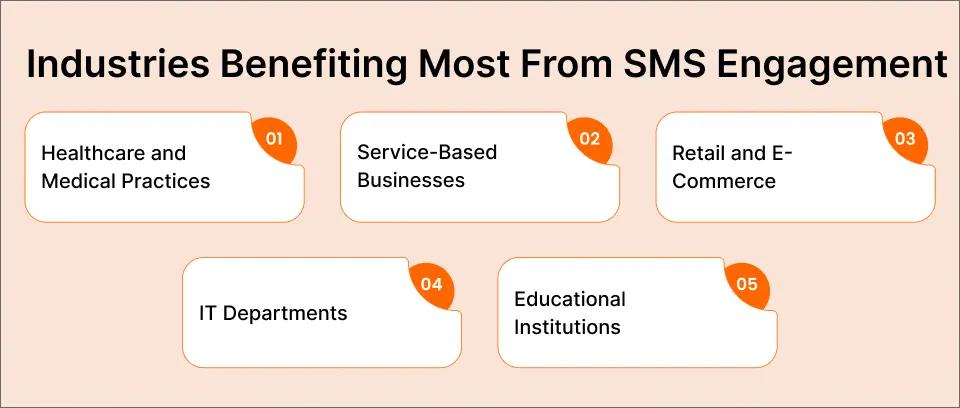
Healthcare and Medical Practices
Healthcare providers use SMS for appointment reminders, prescription notifications, and patient communication. With no-show rates costing thousands monthly, SMS reminders deliver immediate ROI.
Service-Based Businesses
Salons, spas, auto shops, and home service providers rely on appointment-based revenue. SMS confirmations, reminders, and follow-ups keep schedules full and customers satisfied.
Retail and E-Commerce
Order confirmations, shipping updates, and promotional offers drive repeat purchases and reduce support inquiries.
IT Departments
IT teams send critical system alerts via SMS to ensure on-call staff receive notifications even when email is down.
Schools and Educational Institutions
Emergency notifications, event reminders, and parent communication benefit from SMS’s immediate delivery.
Start Boosting Customer Engagement With SMS Today
Customer engagement doesn’t have to be complicated. The strategies in this guide work because they’re based on how customers actually want to communicate: quickly, personally, and on their phones.
The businesses seeing the best results aren’t the ones with the fanciest SMS platforms. They’re the ones that actually use SMS consistently because their systems are simple enough for the entire team to adopt.
With TextBolt, you can implement every strategy in this article directly from your existing Gmail. No new software to learn. No complex dashboards. No single points of failure.
Your customers are waiting to hear from you. The question is whether they’ll actually see your message.
Start your free 7-day trial with TextBolt and send your first engagement text in 30 minutes.
Frequently Asked Questions
How often should I send SMS to my customers?
Send texts only when they are genuinely useful like reminders, updates, and important offers rather than daily promotions.
Can customers reply to SMS sent with TextBolt?
Yes. Replies to your SMS can come back into Gmail as normal email threads, so your team can continue the conversation directly from the inbox.
Do customers really prefer SMS over email for engagement?
For urgent or time sensitive messages, many customers respond faster to SMS because texts are short, direct, and usually read within minutes, while emails often sit unread.
Do I need any tool besides Gmail to use TextBolt?
No. Once you install TextBolt from the Google Workspace Marketplace and complete setup, you can send and receive SMS directly inside Gmail without using a separate dashboard for daily work.