
- The Problem: Your Michelin Connected Fleet Alerts Are Configured Correctly. They’re Still Not Arriving.
- Why This Hits Michelin Connected Fleet Users Especially Hard
- The Real Case: A Commercial Security Patrol Fleet in Ft. Lauderdale
- The Fix: Redirect the Gateway Domain. Don’t Touch Anything Inside Michelin.
- Two Ways to Configure This in Michelin Connected Fleet
- Results for SecurityOpsFL
- Who This Applies To (Beyond Security Fleets)
- What We Learned
- Frequently Asked Questions About Email-to-SMS for Financial Alerts
Restore Michelin Connected Fleet SMS in 15 Minutes
Your Michelin Connected Fleet Alerts Went Silent. T-Mobile Killed @tmomail.net. Here’s How a Florida Security Fleet Got Their Geofence SMS Back

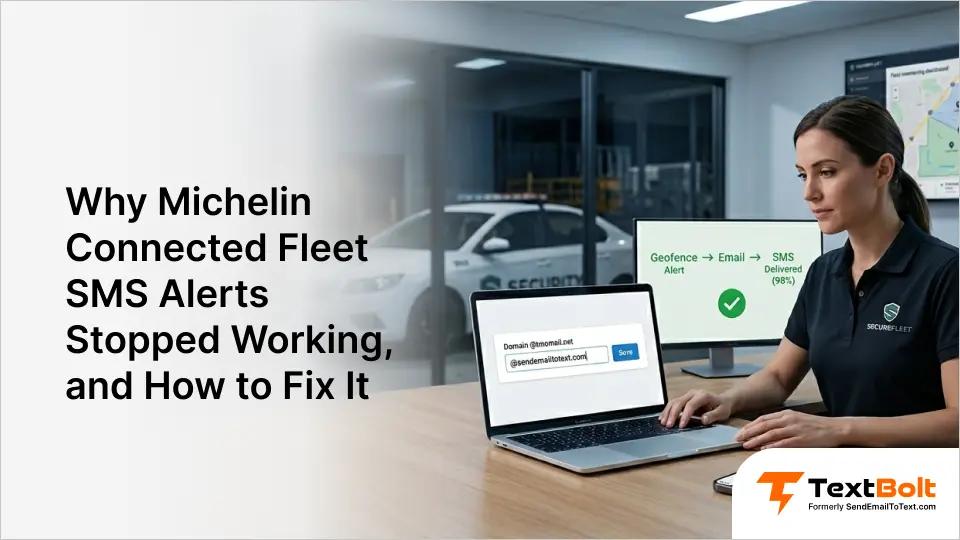
TLDR: T-Mobile’s @tmomail.net email-to-SMS gateway went effectively offline in December 2024. If you use Michelin Connected Fleet (formerly NexTraq) and your geofence alerts, speeding alerts, after-hours alerts, or driver behavior notifications have been getting weird or stopping altogether, that’s why. A commercial security company in Ft. Lauderdale (patrol fleet, 24/7 operations, can’t afford silent alerts) had the same problem. We’ll call them SecurityOpsFL. They fixed it without touching a single setting inside Michelin Connected Fleet’s alert configuration, with no help from Michelin support, and no developer on staff. Total time: under 15 minutes.
The Problem: Your Michelin Connected Fleet Alerts Are Configured Correctly. They’re Still Not Arriving.
If you’re here, it’s probably because one of these things is happening:
- Geofence alerts from Michelin Connected Fleet (the product formerly known as NexTraq in North America) stopped showing up on somebody’s phone.
- Speeding notifications went missing for a couple of weeks and then came back, sporadically.
- Your after-hours movement alerts are hitting email fine but never landing as SMS.
- Your patrol dispatch team is getting emails about events but nobody’s getting the text message they used to rely on.
- Your alert rules inside Michelin Connected Fleet are identical to what they’ve always been. Nothing changed on your end.
The alert configuration is not the problem. The phone carrier is the problem. Specifically, T-Mobile.
What Actually Happened in December 2024
T-Mobile’s @tmomail.net email-to-SMS gateway, the free service that for decades converted emails into text messages for T-Mobile subscribers, went effectively offline in December 2024. There was no single press release, no dramatic shutdown date, no formal customer communication. It just stopped working. Reliability collapsed through Q4 of 2024 and by January 2025, most senders were getting either silent failures or bounces. If you’re still sending to tmomail.net, the T-Mobile email to SMS migration guide walks through what broke and how to fix it.
This isn’t a T-Mobile-only story. It’s the end of the whole carrier-run email-to-SMS era:
- Sprint shut down its gateway in early 2022 (absorbed into T-Mobile).
- Boost Mobile followed shortly after.
- T-Mobile (
@tmomail.net) went effectively offline in December 2024. - AT&T (
@txt.att.net,@mms.att.net) permanently discontinued on June 17, 2025, see the AT&T email to text shutdown guide for the replacement path. - Verizon (
@vtext.com,@vzwpix.com) is in a phased shutdown with full cutoff by March 31, 2027, already operating at a 30% to 40% silent failure rate. The Verizon vText migration guide covers how to move before the hard deadline.
If any part of your Michelin Connected Fleet alert setup was sending to those domains, those alerts are either already failing or about to.
Restore Your Fleet Alerts
Redirect Michelin alerts to sendemailtotext.com and get SMS on every carrier.
Why This Hits Michelin Connected Fleet Users Especially Hard
The Platform’s Scale Makes Quiet Failures Expensive
Michelin Connected Fleet is not a small product. It’s the consolidated brand that Michelin built by acquiring three major regional telematics players:
- NexTraq (North America, acquired by Michelin in 2017, previously acquired by FleetCor in 2013) — the Atlanta-based backbone of the North American product.
- Masternaut (Europe, acquired by Michelin in 2019) — one of the fastest-growing telematics platforms in Europe.
- Sascar (South America) — Michelin’s Latin American telematics investment.
The three were unified under the Michelin Connected Fleet brand in 2022, and the North American product was formally re-branded to “MICHELIN Connected Fleet, Powered by NexTraq” in February 2023.
Together, that platform now:
- Processes data from over 600,000 connected vehicles
- Serves 70,000 customers across 48 countries
- Handles roughly 300 million journeys per year
- Supports up to 10,000 simultaneously tracked vehicles per customer instance
- Employs 200+ people in the North American operation alone
That’s a staggering amount of outbound alert traffic — geofence crossings, speeding events, harsh braking, idle time, after-hours movement, HOS (Hours of Service) infringements, predictive maintenance triggers, unauthorized movement flags, tire pressure thresholds, and the rest of the sensor suite. A non-trivial fraction of those alerts used to ride out via @tmomail.net, @txt.att.net, and @vtext.com. The operators on the other end of those alerts expected a text on their phone. For many of them, that text stopped arriving.
Michelin Connected Fleet Isn’t Going to Fix This for You
To be blunt: this isn’t a bug Michelin Connected Fleet needs to fix, and they can’t fix it even if they wanted to. The product is doing exactly what it always did, firing an email to a recipient address when an alert condition is met. That email is being delivered to the address you configured. The failure is happening after Michelin hands the message off to the carrier. The carrier’s front door is closed. That’s a Michelin-external problem.
Practically, what that means for you as a Michelin Connected Fleet customer:
- You won’t get a fix from support — because from support’s perspective the alert ran correctly.
- You won’t see it in the Michelin Connected Fleet audit log as a failure — because the email did leave.
- You won’t know until somebody complains — that a patrol vehicle went outside its zone and nobody got paged.
- Your renewal discussion won’t include this — until it becomes a blame-shifting session.
For a security patrol company, a refrigerated transport operator, a field-service fleet, or a construction company relying on after-hours theft alerts, “the text didn’t arrive” is a business-critical failure.
The Real Case: A Commercial Security Patrol Fleet in Ft. Lauderdale
Let’s walk through an actual example. We’re anonymizing details by client request, but the industry, stack, scale, and outcome are all real. We’ll call the company SecurityOpsFL.
Who They Are
SecurityOpsFL is a commercial and construction security services company headquartered in Ft. Lauderdale, Florida. Their operational model is what the industry calls mobile patrol, they run a fleet of marked patrol vehicles covering commercial and construction sites across South Florida, 24/7, including unmanned overnight zones, high-value construction sites, and gated commercial properties.
Their fleet telematics stack is built on Michelin Connected Fleet (the Powered-by-NexTraq product for North America). They use it for:
- Geofencing alerts — when a patrol vehicle leaves its assigned zone (a common after-hours issue, sometimes benign, sometimes not)
- Speeding alerts — critical for liability in a marked vehicle. A patrol unit doing 55 in a 35 is an insurance story waiting to happen.
- After-hours movement — when a vehicle moves outside of the scheduled shift window
- Harsh braking and acceleration — driver coaching and accident prevention
- Idle-time monitoring — fuel cost management
All of those alerts flowed out of Michelin Connected Fleet as emails, got routed to a list of operator phone numbers at @tmomail.net (because most of the patrol team was on T-Mobile), and landed as SMS on the operator’s phone within a minute or two of the event.
What Broke
Starting around Q4 2024, the operations manager noticed alerts were getting flaky. Sometimes they arrived. Sometimes they didn’t. By the time they really started to pay attention, it was obvious: T-Mobile SMS alerts had essentially stopped. Verizon alerts were intermittent. AT&T ones (for the handful of operators on AT&T) were still working at that point but showing signs of stress.
The operations manager did what any competent person would do:
- Checked the alert rules in Michelin Connected Fleet — all correct.
- Fired a test geofence event — confirmed in Michelin’s admin panel that the email went out.
- Checked the operators’ phones — nothing.
- Contacted Michelin support — “your alert was sent, please check your delivery system.”
- Contacted T-Mobile customer support — a runaround about spam filtering and app preferences.
- Googled “tmomail.net not working” — discovered he was one of thousands of users hitting the same wall.
This is where most Michelin Connected Fleet customers in this position end up. They spend a week or two chasing it, get hints of the carrier shutdown, and then have to figure out what to do about it.
The Constraint: They Couldn’t Change Their Michelin Connected Fleet Configuration
Here’s the thing that made this interesting. SecurityOpsFL wasn’t interested in, and arguably couldn’t, reconfigure Michelin Connected Fleet’s alerting subsystem.
- They’re not Michelin power users. They’re security operators. They have a configuration that works; they don’t want to touch it.
- Alert rules are tied to vehicles, zones, shifts, and operators. Reworking the delivery layer across all of them would take hours per operator, times dozens of operators.
- Operator turnover is normal in security. Every time someone joins or leaves, you’d have to re-do whatever custom configuration you added.
- Michelin support can’t really help — because this is downstream of their product.
They needed a fix that kept Michelin Connected Fleet doing exactly what it’s always done, but got the SMS to land reliably on every phone, regardless of carrier.
The Fix: Redirect the Gateway Domain. Don’t Touch Anything Inside Michelin.
The insight is simple once you see it. Michelin Connected Fleet sends an email. That email has a recipient address on the @ side. The part before the @ is the operator’s phone number. The part after the @ is the carrier gateway, and the carrier gateway is the part that’s broken.
You don’t need to change Michelin. You need to change the @domain.com that the emails are being sent to.
Before
Michelin Connected Fleet was sending alerts to addresses like:
+19545551234@tmomail.net
+19545555678@vtext.com
+19545559012@txt.att.net
All three of those domains are either dead, dying, or about to die.
After
SecurityOpsFL updated the recipient addresses in Michelin Connected Fleet’s alert rules (or used a forwarding rule — more on that in a moment) so that every alert goes to:
+19545551234@sendemailtotext.com
+19545555678@sendemailtotext.com
+19545559012@sendemailtotext.com
Same phone numbers. Different domain. One compliant gateway that auto-detects whether the recipient is on T-Mobile, Verizon, AT&T, US Cellular, Bell, Rogers, or any other US/Canadian carrier, and routes accordingly.
The per-carrier dropdown is gone. The per-carrier guessing is gone. One domain works for everyone.
Two Ways to Configure This in Michelin Connected Fleet
There are two ways to make this change work. Which one applies to you depends on how Michelin Connected Fleet is configured to send your alerts.
Option A — Direct (Change the Destination Address)
Use this if: You can set the recipient email addresses directly inside the Michelin Connected Fleet alert rule, and the alert emails come from a sender address you control (or can authorize in TextBolt).
Steps:
- Log into Michelin Connected Fleet.
- Open the alert rule (Geofence, Speeding, After-Hours, etc.).
- Find the recipient list that currently uses
@tmomail.net,@vtext.com, or@txt.att.net. - Replace the domain with
@sendemailtotext.com. Keep the phone number the same. - Save the rule.
- On the TextBolt side, authorize the sender address that Michelin is using (typically your company’s notification email). The full authorization flow is in the TextBolt setup walkthrough.
Time required: 5–10 minutes per operator, or bulk-edit if you’re updating many at once.
Option B — Forwarding Rule (When Michelin Sends from a No-Reply System Address)
Use this if: Michelin Connected Fleet sends alerts from a system address like noreply@michelin.com or alerts@nextraq.com that you can’t change or authorize on TextBolt.
Steps:
- Configure Michelin Connected Fleet to email alerts to your inbox (e.g.,
dispatch@yourcompany.com). - In your email provider (Gmail, Google Workspace, Outlook, Microsoft 365), set up a forwarding rule:
- Trigger: “Email arrives from Michelin Connected Fleet / NexTraq alerting domain”
- Action: “Forward to
+1XXXXXXXXXX@sendemailtotext.com“
- Because the forwarded email now originates from your inbox, it arrives at TextBolt with an authorized sender — and TextBolt delivers the SMS.
This is the same pattern that a huge number of fleet operators end up using, because most enterprise telematics systems send from a shared system address.
Time required: 15–20 minutes for the first rule, 2 minutes per additional rule.
What the Change Looks Like in Practice
┌────────────────────────────────────────────────────────────────┐
│  BEFORE                                                        │
│                                                                │
│  Michelin Connected Fleet                                      │
│           │                                                    │
│           ▼                                                    │
│   Alert: geofence exit                                         │
│           │                                                    │
│           ▼                                                    │
│   Email → +15551234567@tmomail.net                             │
│           │                                                    │
│           ▼                                                    │
│   T-Mobile gateway (2024-12 onward): ☠  silent failure         │
│           │                                                    │
│           ▼                                                    │
│   Operator's phone: nothing                                    │
└────────────────────────────────────────────────────────────────┘

┌────────────────────────────────────────────────────────────────┐
│  AFTER                                                         │
│                                                                │
│  Michelin Connected Fleet                                      │
│           │                                                    │
│           ▼                                                    │
│   Alert: geofence exit                                         │
│           │                                                    │
│           ▼                                                    │
│   Email → +15551234567@sendemailtotext.com                     │
│           │                                                    │
│           ▼                                                    │
│   TextBolt (10DLC-compliant, carrier auto-detect)              │
│           │                                                    │
│           ├─→ T-Mobile     ✓                                   │
│           ├─→ Verizon      ✓                                   │
│           ├─→ AT&T         ✓                                   │
│           └─→ US Cellular  ✓                                   │
│           │                                                    │
│           ▼                                                    │
│   Operator's phone: SMS delivered, under 10 seconds            │
└────────────────────────────────────────────────────────────────┘
Results for SecurityOpsFL
| Metric | Before (via @tmomail.net / @vtext.com) | After (via @sendemailtotext.com) |
|---|---|---|
| SMS delivery rate (T-Mobile operators) | ~0% (Dec 2024 onward) | 98% |
| SMS delivery rate (Verizon operators) | ~65% with silent failures | 98% |
| Delivery receipts and audit log | None | Full receipts per message |
| Carrier selection required per operator | Yes (manual, error-prone) | No (auto-detected) |
| Time to reconfigure when operators change carriers | 5–10 min per operator | Zero (one domain, all carriers) |
| Total migration time | — | Under 15 minutes end-to-end |
| Changes inside Michelin Connected Fleet | — | 0 (forwarding rule approach) |
| Monthly cost | $0 (carrier gateway was free) | $29–$49 for small fleets |
What Actually Changed in the Business
The numbers above are the mechanical result. The business impact is what matters:
- Geofence alerts now reliably page the right person in under 30 seconds of a vehicle exiting its assigned zone. Prior to the fix, that same alert was a coin flip on T-Mobile and Verizon handsets.
- Speeding alerts are back on every handset. For a marked patrol fleet, this is liability protection — both for the driver and for the company. A speeding incident at 3 a.m. that nobody flagged is a different conversation in depositions than one that was paged and acknowledged.
- After-hours movement alerts are fully operational across the team — which is the entire point of a 24/7 security operation.
- The ops manager stopped spending Monday mornings chasing down missed alerts from Friday nights.
Stop Missing Geofence Alerts
Get every Michelin Connected Fleet SMS delivered, on every carrier, every time.
Who This Applies To (Beyond Security Fleets)
SecurityOpsFL is one shape of this problem. The same pattern applies to every vertical that uses Michelin Connected Fleet — which, given the product’s 70K-customer global footprint, is a lot of the commercial fleet economy.
1. Field Services and Service Fleets
HVAC, plumbing, telecom installers, cable, pest control, appliance repair, elevator service, commercial cleaning. Anyone with trucks, technicians, and a requirement to know where those trucks are in real time. Michelin Connected Fleet’s Field Services product is specifically built for this vertical, and geofence/speeding/route-deviation alerts are core to its value. Every one of those alerts used to ride a carrier gateway.
2. Refrigerated Transport and Cold Chain
Where dispatch and driver-behavior alerts are compliance-critical — temperature excursions, route deviations on shipments of pharma or frozen goods, HOS (Hours of Service) warnings for FMCSA compliance. A missed alert here doesn’t just lose a delivery; it can spoil a truckload of product worth tens of thousands.
3. Construction and Heavy Equipment
Construction fleets use Michelin Connected Fleet for trailer tracking, asset tracking (cranes, generators, tools), geofencing around job sites, and theft prevention. The overnight unauthorized movement alert is the single most important notification any construction fleet gets — and when that alert doesn’t arrive, you find out the next morning that the bobcat is gone.
4. Hauling and Short-Haul Logistics
Michelin Connected Fleet’s partnership with TruckIT specifically serves the hauling, materials, and construction trucking market. Dispatch, paperless ticketing, job management all of which generate notifications that fleet managers expect on their phone, not just in an email inbox.
5. Long-Haul Trucking (ELD / HOS / Compliance)
FMCSA-certified ELD (Electronic Logging Device) compliance is a Michelin Connected Fleet specialty. HOS infringement alerts and violation notifications need to reach the driver and the dispatcher in real time. The carrier gateway shutdown has degraded that pipe significantly.
6. Patrol, Security, and Fleet-Based Enforcement
Commercial mobile patrol (like SecurityOpsFL), residential patrol HOAs, private security fleets. Here the alert isn’t just operational it’s a chain-of-custody artifact. If a patrol vehicle left a zone, somebody has to know, and there’s usually a written SOP that says so. When the SMS doesn’t arrive, the SOP is technically out of compliance.
7. Electric Vehicle Fleets
Michelin Connected Fleet has an EV-specific product for charging, range, and battery-state monitoring. Charging-complete and low-SOC (state of charge) alerts are commonly routed as SMS so fleet managers can manage asset availability. Same gateway, same problem.
What We Learned
If you’re running Michelin Connected Fleet, NexTraq (the North American product it came from), Masternaut, or Sascar, and your SMS alerts have been flaky, degrading, or outright missing since roughly late 2024, the problem is almost certainly not your telematics stack. It’s the phone carrier gateway at the far end of the pipe.
Carrier email-to-SMS gateways were a free, unmonitored, compliance-free convenience that worked great for twenty years and are now being systematically retired across every major US carrier. Sprint (2022), Boost (early 2023), T-Mobile (December 2024), AT&T (June 17, 2025), and Verizon (March 31, 2027) — that’s the full timeline. By the end of Q1 2027, none of them will work.
The good news for Michelin Connected Fleet customers is that the fix is extraordinarily simple. You don’t rewrite anything. You don’t replatform. You don’t call Michelin support. You don’t reconfigure two years of alert rules. You redirect one domain either inside Michelin Connected Fleet directly (Option A), or via a mail forwarding rule on your own inbox (Option B) — and a 10DLC-compliant gateway takes it from there.
For a commercial security patrol fleet in Ft. Lauderdale, that change took under 15 minutes and restored full alerting across their whole operation. The same pattern works for field services fleets, refrigerated transport, construction, long-haul trucking, and every other vertical that runs on Michelin Connected Fleet.
If you’re a Michelin Connected Fleet customer and you think you might have silent SMS failures right now, the test is straightforward: fire a test geofence or a test speeding alert and see if it lands on a T-Mobile phone. If it doesn’t, and it probably doesn’t, you know where to start.
About TextBolt
TextBolt email-to-SMS gateway provides a 10DLC-compliant service at sendemailtotext.com, built specifically for legacy and enterprise systems that used to rely on free carrier gateways like @tmomail.net, @vtext.com, and @txt.att.net. TextBolt is used by fleet telematics operators, agricultural IoT platforms, industrial monitoring systems, healthcare paging workflows, and commercial security companies that need SMS alerts to land reliably, without rewriting the upstream system.
Fix Your Fleet Alerts Before the Next Missed Event
Frequently Asked Questions About Email-to-SMS for Financial Alerts
Is the Problem Really With T-Mobile, Not With Michelin Connected Fleet?
Yes. Michelin Connected Fleet is generating and sending the email correctly. The alert rule fires, the email is sent, the Michelin audit log shows it as delivered. The failure happens at the next hop, T-Mobile’s @tmomail.net mail server, which is either rejecting silently or no longer processing email-to-SMS at all. Michelin doesn’t have visibility into that, and there’s no setting in Michelin Connected Fleet that would fix it. The fix has to happen in the recipient address.
Do We Have to Reconfigure Every Single Alert Rule in Michelin Connected Fleet?
Not necessarily. If your alerts go through a distribution list or a shared inbox (Option B above, the forwarding-rule pattern), you only touch the forwarding rule once and all downstream alerts inherit it. That’s how most mid-sized fleets handle it. For smaller fleets with a handful of direct recipient addresses, Option A (direct domain replacement) works fine.
Will Changing the Domain Break Anything Else in Michelin Connected Fleet?
No. From Michelin’s perspective nothing has changed, the system is still sending emails to recipient addresses. Only the domain component of those addresses is different. All alert rules, zones, schedules, driver assignments, reports, and audit logs stay exactly the same.
What About Masternaut Customers in Europe or Sascar Customers in Latin America?
The same pattern applies. Masternaut (Michelin’s European platform) and Sascar (Michelin’s South American platform) also use email-to-SMS alerting paths that hit local carrier gateways. European carrier email-to-SMS gateways are also deprecating, some already have. The domain-redirect approach works globally; TextBolt routes US and Canadian messages at domestic rates and supports international delivery at destination-specific pricing.
What About the Other Michelin Connected Fleet Alert Types (Speeding, Harsh Braking, HOS, Predictive Maintenance)?
All of them ride the same email pipe. Geofence, speeding, harsh braking, harsh acceleration, idle-time thresholds, HOS infringements, maintenance-due notifications, trailer-decoupling alerts, EBPMS (Electronic Brake Performance Monitoring System) warnings, TPMS (Tire Pressure Monitoring) thresholds, if it’s a Michelin Connected Fleet notification that was going to a carrier SMS gateway, the fix is the same.
How Long Does This Actually Take to Set Up?
For a single forwarding rule (Option B), a typical operator has it fully working in 10 to 15 minutes, including the test-and-verify step. For direct domain replacement across multiple alert rules (Option A), budget 30 minutes to an hour for a small fleet, longer for bigger ones with hundreds of individual recipient addresses.
Do We Need Our IT Team? A Developer?
No. Neither option requires developer involvement. Option B (the forwarding rule) is a standard email-client feature in Gmail, Google Workspace, Outlook, and Microsoft 365, the ops manager can set it up themselves. Option A is an alert-rule edit inside Michelin Connected Fleet, which is already something fleet admins do routinely.
What Does It Cost?
For small fleets (dozens of vehicles, a few hundred alerts a month), the Starter plan at $29 to $49 per month covers it. For larger fleets, per-message costs are fractions of a cent domestic. The carrier gateway being replaced was free, so this is a new line item, but it’s tiny compared to the cost of a missed alert, a liability incident from a patrol vehicle speeding without notification, or the engineering cost of reconfiguring a fleet telematics stack.
Is This 10DLC Compliant? We’ve Had Audits.
Yes. TextBolt’s inbound email-to-SMS pipeline is fully 10DLC-registered, brand-verified, and compliant with The Campaign Registry’s A2P (Application-to-Person) framework. The carrier gateways being shut down (@tmomail.net, @vtext.com, @txt.att.net) cannot be retrofitted to comply, that’s literally why they’re being retired, so any legacy alerting that used to go through them is technically out of compliance until it’s migrated.
What Happens When Verizon Fully Shuts Down vtext.com in March 2027?
Nothing, if you’re already on TextBolt. Verizon is the last carrier with a still-nominally-live gateway, and they’ve announced full shutdown by March 31, 2027. Customers migrated off the carrier gateways (whether they came from @tmomail.net, @txt.att.net, or @vtext.com) don’t have to do anything when that deadline hits.
Our Michelin Connected Fleet Setup Is Managed by a Reseller or Michelin Account Manager. Do We Need to Loop Them In?
Not necessarily. The forwarding-rule approach (Option B) sits entirely on your side, neither Michelin nor your reseller needs to touch anything. For Option A, the direct replacement, the alert-rule edit is something you or your reseller can do inside the Michelin Connected Fleet admin. Either way, it’s a fast change. It’s worth giving your account manager a heads-up just so they’re aware of the dependency, but they don’t have to do the work.