
- The Real Challenges With Traditional Marketing Channels
- Understanding SMS Marketing and Email Marketing
- SMS vs Email Marketing: Key Performance Metrics
- When to Use SMS Marketing
- When SMS Falls Short
- When to Use Email Marketing
- The Cost Comparison: What You’ll Actually Pay
- The Compliance Factor: What You Must Know
- Combining SMS and Email Marketing: The Smart Approach
- Why Smart Businesses Are Choosing Email-to-SMS
- Stop Choosing Between Channels. Start Using Both.
- Frequently Asked Questions
Send SMS Without Leaving Email
SMS vs Email Marketing: Which Channel Delivers Better Results?

Every business owner faces the same question: should you invest in SMS marketing or email marketing? With limited time and budget, choosing the wrong channel means wasted resources and missed opportunities.
Here’s the reality most comparisons won’t tell you: in 2025, this isn’t an either/or decision anymore.
SMS delivers a 98% open rate compared to email’s 20-28%. But email offers richer content and lower costs per message. The businesses seeing the best results aren’t choosing between them. They’re using email-to-SMS to get email’s familiar workflow with SMS’s superior engagement.
This guide breaks down the real differences between SMS and email marketing, when to use each, and how smart businesses are combining both channels without adding complexity to their operations.
The Real Challenges With Traditional Marketing Channels
Before diving into the comparison, let’s address why this decision feels so difficult in the first place.
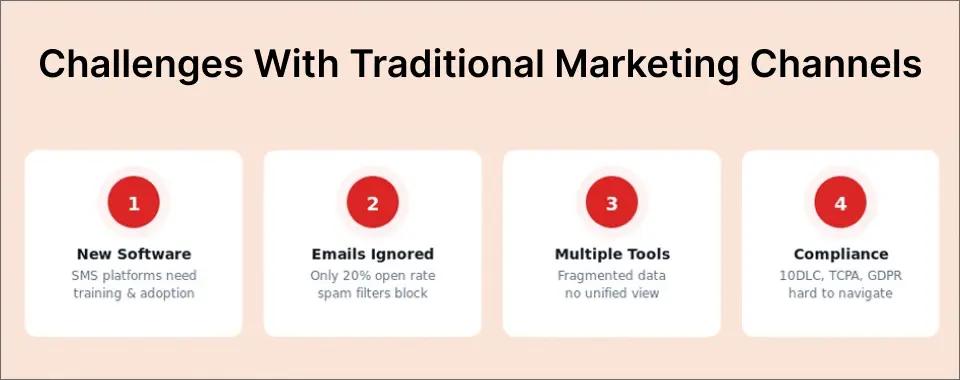
Challenge 1: SMS Platforms Require Learning New Software
Most SMS marketing platforms come with dashboards, contact management systems, and workflows that your team needs to learn from scratch. That’s training time, adoption friction, and another login to manage.
Challenge 2: Email Gets Ignored
Even well-crafted emails sit unopened in crowded inboxes. Promotional emails compete with hundreds of other messages, and spam filters catch legitimate business communication. Your appointment reminder doesn’t help if the customer never sees it.
Challenge 3: Managing Multiple Communication Tools
Running separate platforms for email and SMS means duplicate contacts, inconsistent messaging, and no unified view of customer conversations. When a customer replies to your text, who sees it? Where does it go?
Challenge 4: Compliance Complexity
SMS marketing requires 10DLC registration, TCPA compliance, and proper opt-in management. Email has CAN-SPAM and GDPR requirements. Most small businesses don’t have dedicated compliance teams to navigate both.
The good news? There’s a simpler approach that eliminates these challenges while giving you access to both channels.
Tired of Managing Separate Marketing Platforms?
TextBolt lets you send SMS directly from Gmail. Your team already knows how to use it. No new software, no training, no complexity.
Understanding SMS Marketing and Email Marketing
Before comparing performance, let’s clarify what each channel does best.
What is SMS Marketing?
SMS marketing uses text messages to communicate with customers on their mobile phones. These messages appear directly on the lock screen, creating immediate visibility that no other channel matches.
Common SMS marketing uses include:
- Appointment reminders and confirmations
- Flash sales and limited-time offers
- Order status and shipping updates
- Payment reminders
- Emergency notifications
- Two-factor authentication codes
SMS works best for time-sensitive, action-oriented messages where immediate attention matters. The 160-character limit transforms from constraint to advantage forcing clarity, eliminating fluff, and creating messages customers can process in seconds.
What is Email Marketing?
Email marketing delivers messages to customer inboxes, allowing for rich content including images, formatting, and lengthy explanations. It excels at relationship-building and content that requires more context.
Common email marketing uses include:
- Newsletters and content marketing
- Product announcements and launches
- Onboarding sequences
- Detailed promotional campaigns
- Educational content and guides
- Company updates and news
Email works best for content-rich communications where customers can engage at their own pace. Interestingly, 85% of people now open emails on mobile devices, blurring the line between channels.
SMS vs Email Marketing: Key Performance Metrics
The numbers tell a clear story about how each channel performs.
Open Rates: SMS Dominates
SMS marketing achieves a 98% open rate, with 90% of messages read within three minutes of delivery. Text messages appear directly on the phone’s lock screen, making them nearly impossible to miss. The average response time for SMS is just 90 seconds.
Email marketing shows a wide performance range. Overall email open rates average 43.46% (MailerLite 2025), but commercial and promotional emails see significantly lower engagement e-commerce averages just 32.67%, travel 30.1%, and retail 37.47%. Busy inboxes, spam filters, and promotional tabs all reduce visibility.
On Gmail, only 58% of emails reach the primary inbox, with 38% filtered to promotional tabs (EmailToolTester), while SMS maintains 97% deliverability with minimal filtering. This inbox fragmentation means your carefully crafted email competes with hundreds of other messages, while SMS appears directly on the lock screen.
The takeaway: If your message must be seen and acted upon quickly, SMS wins decisively.
Click-Through Rates: SMS Leads Again
SMS click-through rates average 19-36% when messages include links. The immediacy and personal nature of text messages drives action, making SMS one of the most effective channels to boost customer engagement.
Email click-through rates average 2.09-2.6% across industries. Statista data shows e-commerce email marketing CTR at 1.47% for promotional campaigns. Even opened emails often get scanned and forgotten without action.
The takeaway: SMS drives more engagement per message sent. This immediacy translates directly to enhanced customer satisfaction.
Conversion Rates: Both Can Perform
SMS conversion rates typically range from 21-30%, with some industries seeing rates as high as 40%. The urgency of text messages accelerates decision-making. According to SAP Emarsys research, 50% of consumers have made purchases directly after receiving a branded text message.
Email conversion rates average around 3-15%, varying significantly by industry and campaign type. Well-segmented email campaigns can achieve strong results, particularly for considered purchases where customers need more information.
The takeaway: SMS converts faster for impulse and time-sensitive purchases, while email builds longer-term customer value.
Return on Investment: The Full Picture
According to industry research, SMS marketing generates approximately $71 for every $1 spent, while email marketing returns $36-$42 per dollar invested.
However, email’s lower cost per message means you can reach more people for the same budget. The right channel depends on your specific goals and audience.
Audience demographics matter too. Younger consumers (Gen Z and Millennials) strongly prefer SMS for business communication, while older demographics often favor email. Consider your customer base when choosing channels.
| Metric | SMS Marketing | Email Marketing |
| Open Rate | 98% | 20-28% |
| Click-Through Rate | 19-36% | 2.6-4% |
| Conversion Rate | 21-30% | 3-15% |
| ROI per $1 Spent | $71 | $36-$42 |
| Cost per Message | $0.01-$0.05 | $0.001-$0.03 |
| Response Time | 90 seconds | 90 minutes |
| Spam/Filter Rate | ~3% | Up to 85% |
| Character Limit | 160 chars | Unlimited |
| Best For | Urgency, reminders | Nurturing, content |
When to Use SMS Marketing
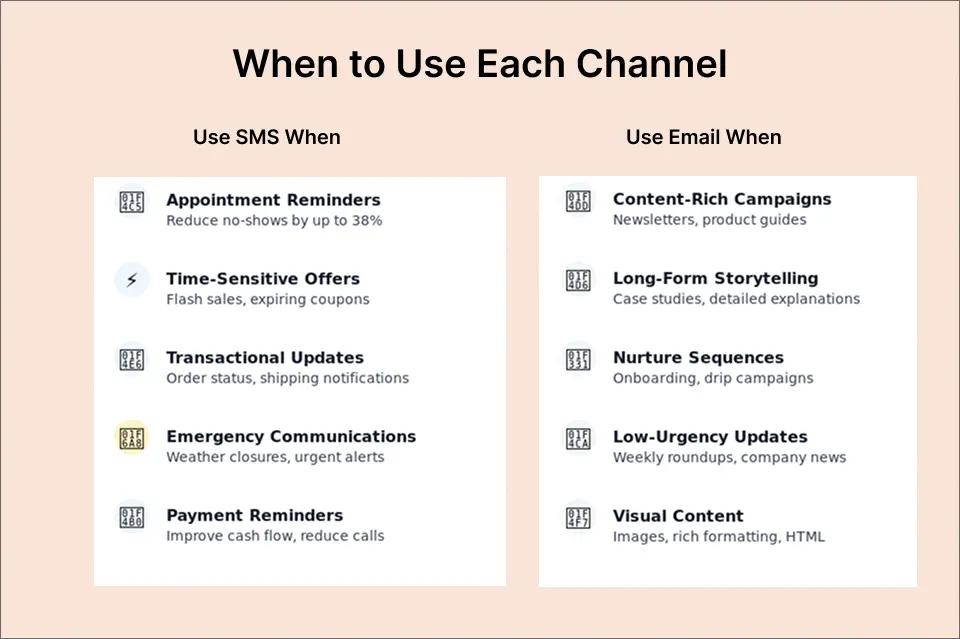
SMS excels in specific scenarios where immediacy and guaranteed visibility matter most.
1. Appointment Reminders and Confirmations
Healthcare providers, salons, and service businesses see up to 38% reduction in no-shows when using SMS appointment reminders. A text 24 hours before the appointment, followed by a same-day reminder, keeps customers informed without cluttering their email.
2. Time-Sensitive Offers
Flash sales, limited-time discounts, and expiring coupons need immediate attention. SMS ensures customers see the offer before it expires. Learn how to send promotional offers via email-to-SMS without switching platforms.
3. Transactional Updates
Order confirmations, shipping notifications, and delivery updates perform better via SMS. Customers expect and appreciate real-time status updates on their phones.
4. Emergency Communications
Weather closures, schedule changes, and urgent notifications require guaranteed delivery. SMS provides the reliability that email cannot match for critical messages. See how businesses use email-to-SMS for emergency alerts to reach staff and customers instantly.
5. Payment Reminders
Payment reminder texts get seen and acted upon faster than email reminders, improving cash flow and reducing follow-up calls.
When SMS Falls Short
SMS isn’t the right choice for every situation. Understanding its limitations helps you use it strategically.
1. Complex or Detailed Messages
The 160-character limit means SMS can’t handle product specifications, detailed instructions, or nuanced explanations. If your message needs context, visuals, or multiple paragraphs, email wins.
2. Rich Visual Content
SMS is text-only by default. While MMS supports images, it costs more per message and doesn’t render consistently across all devices. If you’re deciding between formats, it’s important to understand the key differences between SMS and MMS, including pricing, character limits, and delivery behavior. Email’s HTML formatting gives you full creative control.
3. High-Volume Sending on a Budget
At $0.01-$0.05 per message, SMS costs add up quickly for large lists. Sending 10,000 emails might cost $10-$30, while 10,000 texts could run $100-$500. For broad awareness campaigns, email is more cost-effective.
4. Frequency-Sensitive Communications
Customers tolerate daily emails far better than daily texts. SMS feels more personal and intrusive, so over-messaging leads to higher opt-out rates. Reserve SMS for high-value, time-sensitive messages.
5. Compliance-Heavy Industries
SMS requires stricter opt-in consent than email. TCPA regulations carry penalties of $500-$1,500 per unsolicited message. If your compliance resources are limited, email’s CAN-SPAM requirements are less punishing.
The bottom line: SMS excels at urgency and engagement, but email handles volume, content depth, and cost efficiency better. Smart marketers use both.
When to Use Email Marketing
Email remains the better choice for certain communication types.
Content-Rich Campaigns
Newsletters, product guides, and educational content need the formatting options email provides. Images, headers, and detailed explanations work better in email format.
Long-Form Storytelling
Brand stories, case studies, and detailed product explanations require more than 160 characters. Email gives you space to build compelling narratives.
Nurture Sequences
Multi-step onboarding campaigns, drip sequences, and relationship-building content work well in email where customers can engage at their own pace. However, adding SMS touchpoints to client onboarding sequences can boost engagement at critical moments.
Lower-Urgency Communications
Weekly updates, monthly roundups, and general announcements don’t require immediate attention. Email keeps customers informed without creating urgency fatigue.
The Cost Comparison: What You’ll Actually Pay
Understanding the true costs helps you budget effectively.
SMS Marketing Costs
Most SMS platforms charge $0.01-$0.05 per text message, though costs vary by volume and provider. A 1,000-message campaign might cost $10-$50 for the messages alone.
Additional costs include:
- Monthly platform fees ($20-$100+)
- 10DLC registration fees ($4-$40 for brand registration)
- Toll-free number fees ($2-$15/month)
- Per-user fees on some platforms ($10/user/month)
Email Marketing Costs
Email platforms typically charge based on subscriber count rather than messages sent. A 1,000-subscriber list might cost $0-$50/month depending on the platform.
Per-email costs work out to $0.001-$0.03 per message, making email significantly cheaper for high-volume sending.
The Hidden Cost: Platform Complexity
What the per-message math misses is the operational overhead. Managing separate SMS and email platforms means:
- Two sets of contacts to maintain
- Two dashboards to monitor
- Two systems for your team to learn
- Fragmented customer conversation history
This is where email-to-SMS solutions like TextBolt change the equation. Instead of managing separate platforms, you send SMS directly from your existing email client.
Get SMS Results Without Learning New Software
With TextBolt, send texts directly from Gmail or Outlook. Up to 98% delivery rate, 30-minute setup, and your team already knows how to use it.
The Compliance Factor: What You Must Know
Both channels come with legal requirements that can trip up unprepared businesses.
SMS Compliance Requirements
- TCPA (Telephone Consumer Protection Act) requires explicit consent before sending marketing texts. Violations can cost $500-$1,500 per unsolicited message.
- 10DLC Registration is now required for all business SMS in the US. This involves registering your business and campaign types with carriers to ensure delivery.
- CTIA Guidelines set standards for message content, opt-out handling, and frequency. Non-compliance can result in carrier filtering or blocking.
Email Compliance Requirements
- CAN-SPAM requires accurate sender information, clear unsubscribe options, and honest subject lines. Penalties reach up to $50,120 per email violation.
- GDPR (for EU recipients) requires explicit consent and data handling transparency.
How TextBolt Simplifies SMS Compliance
TextBolt handles 10DLC registration as part of the setup process. Your business gets verified, campaign types get registered, and opt-out handling works automatically. You send the message; the compliance infrastructure runs in the background.
Combining SMS and Email Marketing: The Smart Approach
Research shows that companies using omnichannel marketing strategies retain nearly 90% of their customers, compared to just 33% for single-channel approaches.
The question isn’t which channel to use. It’s how to use both effectively without doubling your workload.
Traditional Integration: More Platforms, More Complexity
The conventional advice says to run SMS and email platforms separately, then use automation tools like Zapier to connect them. This works but adds:
- More subscriptions to manage
- More potential failure points
- More logins for your team
- Fragmented customer records
TextBolt Email-to-SMS Alternative: Unified Workflow
TextBolt email-to-SMS services offer a simpler approach. You compose messages in Gmail or Outlook, send them to a special address format, and the message is delivered as SMS.
Benefits of this approach:
- Zero learning curve (if you can email, you can text)
- Single inbox for all communications
- Team access without additional per-user fees
- Complete audit trail in your sent folder
- Replies come back to your email inbox
- Easy setup for automated text messages using email scheduling
Practical Combined Strategy Examples
Appointment-Based Businesses:
- Email: Send initial booking confirmation with appointment details
- SMS: Send 24-hour reminder via email-to-SMS
- SMS: Send same-day reminder 2 hours before
- Email: Follow up with feedback request post-appointment
E-Commerce:
- Email: Welcome sequence and product recommendations
- SMS: Order confirmation and shipping updates
- Email: Detailed product care and usage guides
- SMS: Flash sale announcements and expiring offers
Professional Services:
- Email: Proposals, contracts, and detailed project updates
- SMS: Meeting reminders and quick status confirmations
- Email: Monthly reports and invoices
- SMS: Payment reminders for outstanding invoices
Why Smart Businesses Are Choosing Email-to-SMS
The SMS vs email debate assumes you must pick one or switch between platforms. Email-to-SMS eliminates this false choice.
You Already Know How to Use It
Your team sends emails every day. With TextBolt, sending SMS works the same way. Compose an email, address it to [phonenumber]@sendemailtotext.com, and hit send. No training required.
Team Collaboration Built In
Traditional SMS often depends on one person with the phone or platform access. With email-to-SMS, anyone on your team can send texts from their email. When Sarah calls in sick, Tom covers seamlessly.
Professional Business Number
Messages appear from your dedicated toll-free business number, not a random carrier address or personal phone. Recipients see professional communication, not spam.
Up to 98% Delivery Rate
TextBolt uses 10DLC-registered business routes, not unreliable carrier gateways. Your messages actually reach recipients.
Complete Audit Trail
Every text lives in your Gmail sent folder with timestamps and delivery confirmation. For compliance-conscious industries like healthcare, this documentation matters.
Stop Choosing Between Channels. Start Using Both.
The SMS marketing vs email marketing debate misses the point. Each channel excels at different things:
- SMS wins for immediacy, open rates, and time-sensitive communications
- Email wins for content depth, cost efficiency, and relationship nurturing
The smartest businesses use both. And the smartest approach is using them from a single, familiar interface.
Ready to Try Email-to-SMS?
TextBolt lets your entire team send professional text messages directly from Gmail. No new software. No learning curve. No separate logins.
- 7-Day Free Trial – 100 SMS messages included
- 30-Minute Setup – Business verification built-in
- Up to 98% Delivery Rate – Carrier-verified 10DLC compliance
- Zero Learning Curve – Works exactly like Gmail
With email-to-SMS, you get SMS’s 98% open rates using the email workflow your team already knows. No new platforms to learn. No separate contacts to manage. No fragmented customer conversations.
Frequently Asked Questions
Is SMS marketing more effective than email marketing?
For messages requiring immediate attention, SMS significantly outperforms email with 98% open rates versus 20-28%. However, email excels for content-rich communications and relationship building. The most effective strategy combines both channels based on message type and urgency.
Can I send SMS from my email?
Yes. Email-to-SMS services like TextBolt let you compose messages in Gmail or Outlook and deliver them as text messages. This combines email’s familiar workflow with SMS’s engagement rates.
Do I need separate platforms for SMS and email marketing?
Not necessarily. Email-to-SMS solutions allow you to send texts directly from your existing email client, eliminating the need for a separate SMS platform for many use cases.
Is SMS marketing legal in the USA?
Yes, SMS marketing is legal in the USA, but only if you follow strict rules. You must get prior express consent before sending promotional texts, clearly identify your business, include an easy opt-out (like “Reply STOP to unsubscribe”), and comply with TCPA, FCC, and carrier guidelines to avoid fines.