
- What is Email-to-SMS?
- How Does Email-to-SMS Work? (4 Simple Steps)
- What’s the Difference Between Carrier Gateways and Modern Platforms?
- What are the Key Benefits of Email-to-SMS? (7 Reasons to Use it)
- What are the Common Business Use Cases for Email-to-SMS?
- Healthcare: Appointment Reminders and Patient Notifications
- IT Departments: Critical Alerts and System Monitoring
- Small Businesses: Customer Service and Operational Updates
- Schools: Emergency Alerts and Parent Communication
- Professional Services: Client Reminders and Scheduling
- Multi-Location Businesses: Centralized Team Coordination
- Email-to-SMS vs. SMS Marketing Platforms: Which Should You Choose?
- Use TextBolt for Email-to-SMS Service
- Frequently Asked Questions
Turn your Gmail into a business texting platform
What is Email-to-SMS? A Complete Business Guide

Your carrier gateway just stopped working. AT&T’s txt.att.net bounced your appointment reminders back. Or you’re manually switching between email and a clunky SMS app, wasting 30 minutes daily on communication that should be seamless.
Email-to-SMS lets you send text messages directly from Gmail or Outlook using an email-to-text gateway – TextBolt—the tools you already use every day.. But with carrier gateways like AT&T and Verizon shutting down in 2025, businesses need modern alternatives that actually deliver messages reliably.
This guide explains how email-to-SMS works, why businesses rely on it, and practical options to replace discontinued carrier services. Whether you’re migrating from AT&T’s discontinued gateway or exploring email-based texting for the first time, you’ll understand exactly what it offers and when it makes business sense.
What is Email-to-SMS?
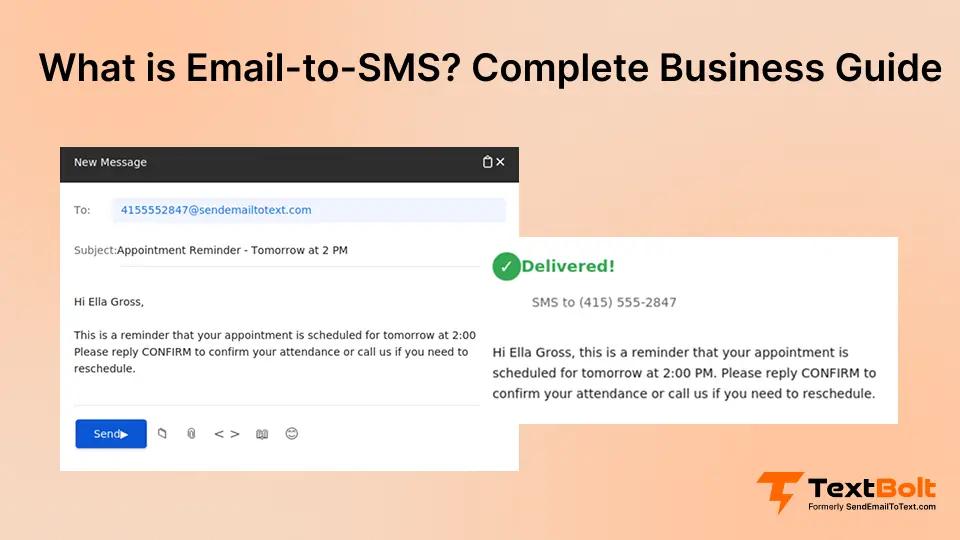
Email-to-SMS is a communication method that converts standard email messages into text messages delivered to mobile phones. You compose an email in Gmail, Outlook, or any email client, send it to a special address format, and the recipient receives it as SMS.
Basic example: You send an email to 5551234567@sendemailtotext.com with the message “Your appointment is confirmed for Tuesday at 2:00 p.m.” Your customer receives this as a text message on their mobile device.
The process works through an email-to-SMS gateway:
- Your email client sends the message to the gateway
- Gateway converts it to SMS format
- Message delivers via cellular networks to the recipient’s phone
The entire process happens in seconds and feels exactly like sending normal email. Learn the detailed setup process in our how to send email to text guide.
Send texts from Gmail
TextBolt connects your existing email to professional SMS delivery with 10DLC compliance. Your team already knows email. Now they can send business texts just as easily.
How Does Email-to-SMS Work? (4 Simple Steps)
Email-to-SMS converts your email into text messages through a straightforward four-step process.
Step 1: Compose your Email-to-SMS Message
Open Gmail, Outlook, Apple Mail, or any email client you use for regular business communication. You don’t need special software or a dedicated SMS application.
Write your message in the email body just as you would for any email. Keep your message under 160 characters if you want it delivered as a single SMS segment. This character limit is a standard SMS restriction, not specific to email-to-SMS.
Character limits:
- Standard SMS: 160 characters per segment
- Unicode/emoji messages: 70 characters per segment
- Longer messages split automatically
The subject line is typically ignored by email-to-SMS gateways, so focus your message content in the body. Some platforms may use the subject line for internal tracking, but recipients only see the body content.
Example: “Hi John, your prescription is ready for pickup at our Main St location. We’re open until 6:00 p.m. today.”
This 98-character message sends as a single SMS segment, ensuring quick delivery and minimal credit usage.
Step 2: Format the Recipient Phone Number
The recipient address follows a specific format: phonenumber@gateway-domain.com. The phone number must include the area code with no spaces, dashes, parentheses, or special characters. Use only digits.
Correct formatting examples:
- 5551234567@sendemailtotext.com (modern platform)
- 12135551234@sendemailtotext.com (with country code for international)
Incorrect formatting (won’t work):
- (555) 123-4567@sendemailtotext.com (contains special characters)
- 555-123-4567@sendemailtotext.com (contains dashes)
- 555 123 4567@sendemailtotext.com (contains spaces)
The gateway domain determines which service processes your message. Modern business platforms use dedicated domains, while legacy carrier gateways used carrier-specific addresses.
Legacy carrier formats (discontinued in 2025):
- AT&T: phonenumber@txt.att.net (shut down June 2025)
- Verizon: phonenumber@vtext.com (shut down August 2025)
- T-Mobile: phonenumber@tmomail.net (shut down August 2025)
Most modern platforms provide a consistent domain for all carriers, eliminating the need to know each recipient’s cellular provider.
Step 3: Send your Email and Track Delivery
Click send in your email client. Your email routes through standard email protocols (SMTP) to the email-to-SMS gateway, just like sending any email.
The gateway performs several operations:
- Receives and validates your email, checking the recipient format and sender authentication
- Converts content from email format to SMS protocol, stripping HTML formatting and extracting plain text
- Segments messages longer than 160 characters into multiple parts (each segment uses one message credit)
- Routes to carriers via direct connections with cellular networks (AT&T, Verizon, T-Mobile, etc.)
- Delivers to recipient within seconds under normal network conditions
Delivery rates: Modern platforms with 10DLC sms compliance laws for business messaging achieve up to 98% delivery* because carriers recognize them as legitimate business senders. Legacy carrier gateways achieved only 60-70% delivery as cellular networks increasingly blocked them as potential spam.
Message segmentation: If your message exceeds 160 characters, the gateway automatically splits it into multiple SMS segments:
- 161-320 characters = 2 segments
- 321-480 characters = 3 segments
- And so on
Each segment delivers separately but displays as a single message on most modern smartphones. However, very old phones may show segments separately.
Step 4: Receive SMS Replies Directly in your Email Inbox
When your recipient replies to the SMS, modern email-to-SMS platforms route the response back to your email inbox. This creates a seamless two-way conversation without requiring you to switch applications or log into separate platforms.
How replies work:
- Recipient taps “Reply” on their phone and types a response
- Their SMS reply sends to the gateway’s phone number (the one they received the message from)
- Gateway converts the SMS back to email format
- Email delivers to your inbox, appearing as a reply to your original message
Reply threading: Most email clients display the reply in the same conversation thread as your original message, maintaining complete context. The “From” field shows the recipient’s phone number in email format (e.g., 5551234567@gateway-domain.com), allowing you to simply hit “Reply” to continue the conversation.
Conversation history: All exchanges remain in your email system, providing searchable records of every interaction. This is particularly valuable for businesses requiring audit trails, compliance documentation, or customer service history.
STOP keyword handling: Modern platforms automatically process opt-out requests to maintain TCPA and carrier compliance requirements. When a recipient texts “STOP,” the platform prevents future messages to that number and may notify you via email, ensuring TCPA compliance without manual intervention.
These four steps work the same whether you’re using modern business platforms or legacy carrier gateways, but the reliability and features differ significantly.
What’s the Difference Between Carrier Gateways and Modern Platforms?
Email-to-SMS has evolved significantly. Understanding the difference between discontinued carrier services and modern business platforms helps you choose the right solution.
Why Free Carrier Gateways Failed (AT&T, Verizon, T-Mobile)
Carrier gateways offered free consumer-grade email-to-SMS for years but had significant limitations:
- Free service with no subscription cost
- Send-only with no business features
- Delivery rates of 60-70% (increasingly blocked as spam)
- Zero customer support or troubleshooting
- All shut down in 2025: AT&T in June, Verizon and T-Mobile in August
- Messages showed carrier addresses like “message@vtext.com”
- Single-user only with no team collaboration or audit trail
Carriers discontinued these services because consumer gateways couldn’t meet business messaging compliance (10DLC registration, TCPA, CTIA guidelines). They exited to focus on business APIs requiring developer resources.
What Modern Platforms Offer (and Why They’re Better)
Modern email-to-SMS platforms address carrier gateway limitations with business-grade features:
Core improvements:
- 10DLC compliance for carrier-approved messaging (up to 98% delivery*)
- Professional business toll-free or local numbers
- Multi-user team access from individual email accounts
- Complete audit trail with timestamps and delivery confirmation
- Two-way messaging with replies to email inbox
- Business support and troubleshooting
- 30-minute setup
How they work: Platforms like TextBolt handle 10DLC registration, carrier approval, and compliance automatically. TextBolt specifically designed its platform for businesses transitioning from discontinued carrier gateways—setup takes 30 minutes with zero training required because your team already knows email.
For a deeper understanding of modern email-to-SMS solutions, this guide explains what email-to-SMS software is, how it works, and what features matter for businesses.
When to choose a modern platform:
- Your carrier gateway shut down (AT&T, Verizon, T-Mobile all discontinued in 2025)
- Reliable delivery needed for critical business messages
- Multiple team members require texting capability
- Professional sender identity matters
- Compliance documentation required for regulated industries
Businesses migrating from AT&T’s discontinued txt.att.net service typically transition in 15-30 minutes.
Understanding these differences helps you choose the right platform, but what specific advantages does email-to-SMS provide for your business operations?
What are the Key Benefits of Email-to-SMS? (7 Reasons to Use it)
Email-to-SMS delivers practical advantages that improve business operations, team collaboration, and customer communication.
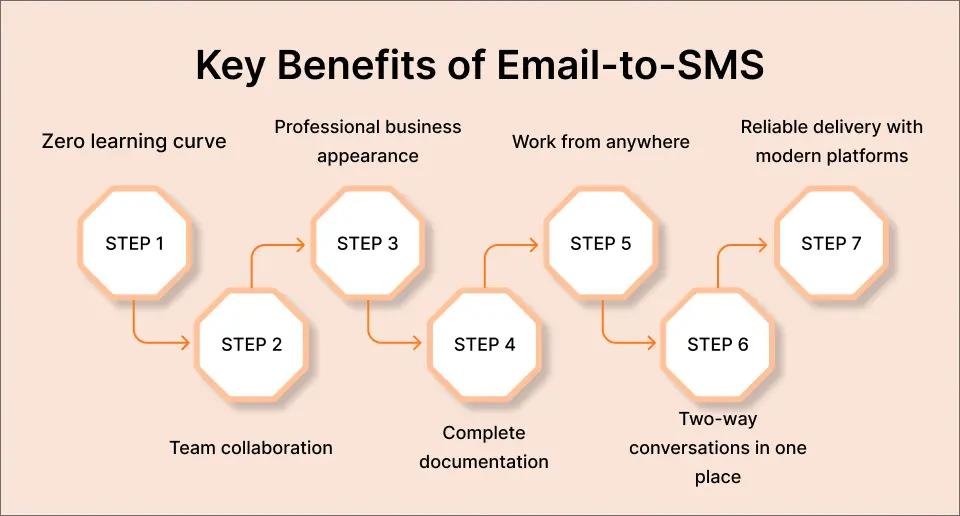
1. Zero Learning Curve
Your team already knows email. Email-to-SMS requires no training, no software installation, no dashboard to learn. You compose messages in Gmail the same way you’ve done thousands of times. The only difference is the recipient address format.
New staff are productive immediately. No training sessions, no user manuals, no asking how the texting system works.
2. Team Resilience and Collaboration
Your business texting shouldn’t depend on one person’s phone. Multiple team members send from individual email accounts using the same business number.
When your office manager takes vacation, anyone covers appointment reminders. When your on-call engineer’s phone dies at 3:00 a.m., another team member sends critical alerts. You eliminate single points of failure that shut down communication.
TextBolt enables this team resilience by giving every staff member their own email-to-SMS access while maintaining centralized message history and a single professional business number.
Message history lives in your email system where it’s searchable, organized, and backed up automatically.
3. Professional Business Appearance
Messages appear from a dedicated business toll-free or local number. Not a personal cell phone. Not a random carrier address. Not “Unknown Sender.”
Recipients see your business number, building trust and recognition. Professional appearance drives higher open rates compared to messages from personal numbers or unknown senders.
4. Complete Documentation and Audit Trail
Every text logs in your email with timestamps, sender identification, and delivery confirmation. You know exactly who sent what message, when, and whether it delivered.
For healthcare, legal, or financial businesses, this documentation provides compliance proof. Dispute resolution becomes straightforward with complete records. Staff accountability improves when message history is transparent and searchable.
5. Work From Anywhere
You’re not tied to a physical phone or specific device. Send texts from your laptop, tablet, or phone. Any device with email access works.
Lost phone? Dead battery? Forgot your device? Your texting capability continues uninterrupted because it’s email-based, not device-dependent.
6. Two-Way Conversations in One Place
Customer replies arrive in your email inbox. Continue conversations without switching apps or logging into separate platforms.
All communication lives in one place: emails, text conversations, file attachments. Search your inbox to find any customer interaction, whether they emailed or texted.
7. Reliable Delivery With Modern Platforms
Modern platforms use 10DLC compliance for carrier-approved business messaging. Up to 98% delivery rates mean critical messages actually reach recipients when timing matters.
Compare to legacy carrier gateways (60-70% delivery, blocked as spam). When you send appointment reminders or time-sensitive alerts, delivery reliability directly impacts revenue and customer experience.
*Delivery rates vary based on carrier policies, message content, and compliance factors.
Turn your Gmail into a business texting platform
TextBolt gives you all these benefits with 30-minute setup, 10DLC compliance handled automatically, and team multi-user access included. No apps to download. No staff training required.
What are the Common Business Use Cases for Email-to-SMS?
Email-to-SMS serves operational communication across industries:
Healthcare: Appointment Reminders and Patient Notifications
Appointment reminders reduce no-shows by 38%. Front desk staff send confirmation texts, prescription notifications, and test result alerts from existing email using HIPAA-compliant healthcare email-to-SMS platforms. No phone dependency when staff call in sick.
Complete message logs support HIPAA considerations for medical appointment confirmation workflows.
IT Departments: Critical Alerts and System Monitoring
Critical server alerts, disk warnings, and security notifications must reach on-call engineers immediately. Monitoring tools like Nagios, Zabbix, and PRTG trigger SMS notifications through email integration.
When production servers go down at 3:00 a.m., text notifications wake the on-call team. Response times improve because alerts bypass email that might go unchecked. IT infrastructure monitoring integrates with email-to-SMS for immediate incident response
Small Businesses: Customer Service and Operational Updates
Appointment confirmations, service updates, and payment reminders keep customers informed. Auto shops text when vehicles are ready. Salons confirm bookings. Consultants send meeting reminders.
This operational communication doesn’t require subscriber lists, drip campaigns, or marketing features. Just reliable notification delivery. Explore small business texting use cases.
Schools: Emergency Alerts and Parent Communication
Emergency alerts reach thousands of parents in seconds for weather closings, lockdowns, or early dismissals. One email to a contact group delivers mass notifications without expensive emergency systems.
Schools also send event reminders, schedule changes, and attendance alerts..
Professional Services: Client Reminders and Scheduling
Lawyers, accountants, and consultants send client meeting reminders, document notifications, and appointment confirmations. Email-to-SMS maintains professional standards while ensuring clients see time-sensitive messages.
Multi-Location Businesses: Centralized Team Coordination
Franchises and retail chains coordinate across locations with centralized messaging. Regional managers update multiple stores from one email. Headquarters communicates policy changes. Location-specific notifications reach local teams.
While email-to-SMS serves these operational needs effectively, businesses often wonder how it compares to dedicated marketing platforms.
Email-to-SMS vs. SMS Marketing Platforms: Which Should You Choose?
The right choice depends on whether you need operational messaging or marketing campaigns.
Email-to-SMS platforms focus on operational communication: appointment reminders, customer service, transactional notifications, time-sensitive alerts. You send from existing email (Gmail, Outlook) without learning new software. Messages deliver as SMS, replies return to your inbox.
Best for straightforward customer notifications, IT alerts, healthcare reminders, or service updates. Setup takes 30 minutes. Staff are productive immediately using familiar email.
SMS marketing platforms like EZ Texting, SimpleTexting, and SlickText serve different needs than operational email-to-SMS platforms. Separate dashboards provide advanced features: contact segmentation, A/B testing, automated campaigns, loyalty programs, contest management.
Best for marketing teams running promotional campaigns with thousands of subscribers or managing complex automation. Setup requires 1-2 hours of training to learn platform interface and features.
Key differences:
| Factor | Email-to-SMS | Marketing Platforms |
| Workflow | Existing email | Separate dashboard |
| Purpose | Operational 1-on-1 | Promotional broadcasts |
| Learning curve | None (it’s email) | Requires training |
| Features | Simplicity, team access | Campaign automation, analytics |
| Cost | Starting $29/month | $39-$500/month |
When to choose each: Use email-to-SMS for appointment confirmations, service notifications, payment reminders, or IT alerts to individual customers. Use marketing platforms for building subscriber lists and running promotional campaigns to thousands.
Many businesses use both: email-to-SMS for operations, marketing platforms for campaigns.
Now that you understand how email-to-SMS works and when to use it, here’s how to get started.
Use TextBolt for Email-to-SMS Service
Email-to-SMS has evolved from free consumer gateways to business-grade platforms built for reliability and compliance. With AT&T, Verizon, and T-Mobile carrier gateways all discontinued in 2025, businesses need modern alternatives that deliver professional features without complexity.
Modern email-to-SMS platforms eliminate the complexity of discontinued carrier gateways while delivering business-grade reliability. You send from existing email, messages deliver with 10DLC compliance, and your team collaborates without device dependency.
Why businesses choose TextBolt for email-to-SMS
TextBolt was built specifically to solve the problems businesses faced when carrier gateways shut down. Unlike generic SMS platforms requiring new software, TextBolt works directly with Gmail and Outlook, the email you already use every day.
Your team sends texts exactly like sending email. No apps to download, no training sessions, no asking IT for help. Office managers set up TextBolt in 30 minutes and start sending appointment reminders immediately. When your medical assistant goes on vacation, any staff member can send prescription notifications from their email without logging into separate systems.
TextBolt handles the complex parts automatically: 10DLC carrier registration, compliance documentation, delivery confirmation tracking, and two-way reply routing. You get up to 98% delivery rates* while your team stays in their inbox. Multi-location businesses use TextBolt because every location sends from the same professional business number, but each staff member uses their individual email account. Complete audit trails show exactly who sent what message, when, and whether it delivered, critical for healthcare, legal, and financial compliance.
Start your free trial and send business texts from email in under an hour. View pricing plans.
Frequently Asked Questions
Can I send email-to-SMS from Gmail or Outlook?
Yes, email-to-SMS works with Gmail, Outlook, Apple Mail, Yahoo, or any SMTP email client. No special software needed. Just compose email and send to phonenumber@gateway-domain.com format. The platform handles conversion and delivery.
Why did AT&T, Verizon, and T-Mobile shut down email-to-text?
Carrier gateways were free consumer services that couldn’t meet business messaging compliance (10DLC registration, TCPA, CTIA). Carriers discontinued them to focus on business APIs requiring developers. Modern platforms replaced carrier gateways with proper compliance and features.
What is 10DLC compliance and why does it matter?
10DLC (10-Digit Long Code) compliance is carrier-approved business messaging registration. It verifies you’re a legitimate business, ensuring up to 98% delivery rates* instead of spam blocking. Modern platforms handle 10DLC registration automatically without you managing technical details.
How long are email-to-SMS messages?
Standard SMS supports 160 characters per segment. Messages with emojis or special characters use Unicode encoding (70 characters per segment). Longer messages split automatically into multiple segments. Modern platforms handle segmentation seamlessly.
Can recipients reply to my email-to-SMS messages?
Yes, with modern platforms, recipient SMS replies route back to your email inbox automatically. Continue two-way conversations without switching apps. All communication lives in email where you can search and reference complete conversation history.
Do I need a developer or IT team to set up email-to-SMS?
No, modern platforms require no coding or technical expertise. Setup takes approximately 30 minutes: create account, verify business, complete carrier registration (platform handles this), start sending. Non-technical office managers complete setup successfully.
What’s the difference between email-to-SMS and SMS APIs like Twilio?
Email-to-SMS platforms provide finished products where you send from email immediately. SMS APIs require developers to build custom interfaces, costing $5,000+ in development plus ongoing maintenance. Email-to-SMS serves non-technical teams; APIs serve developers building custom applications.